Good Certification preparation for #Azure #AI #Data professionals for Mastering Fundamentals

Tags
#az900 #ai900 #dp900 #pl900 #azuread #containers #azure #fundamentals #certification

Good Certification preparation for #Azure #AI #Data professionals for Mastering Fundamentals
#az900 #ai900 #dp900 #pl900 #azuread #containers #azure #fundamentals #certification
The 10 rules every developer should follow while development
Referred Link - https://app.pluralsight.com/course-player?clipId=031aa5d9-fb16-4c05-9843-83b937e2fc2c
Rule 10: Avoid Regions Regions are used in c# to separate various blocks of code in c#. In general regions are used to navigate easily in a large class. If we carefully observe, these regions hide ugly code in a very complex and large class. Instead of using regions, it is advisable to refactor and move the region specific logic to a separate class
Rule 09: Use Exceptions for errors
public bool Login(string userName, string password)
{
if(String.IsNullOrEmpty(userName))
{
return false;
}
//..
return true;
}
In above method, if the username is empty, the method returns false. This can be misleading because, if the username is empty, the login is not even verified and hence it is ideal if we throw an exception instead. The exception would ensure that no further functionality is executed because username is empty
Rule 08: Avoid Boolean parameters for public methods
Instead of passing plain boolean values as parameters, create two separate methods, one for execution of positive flow and another for negative flow. This would ensure we are creating better readable code
Rule 07: Avoid Too many parameters
For readability purposes, if we encounter methods with more than 3 parameters, think of encapsulating those parameters into a separate method
Rule 06: Warnings are Errors
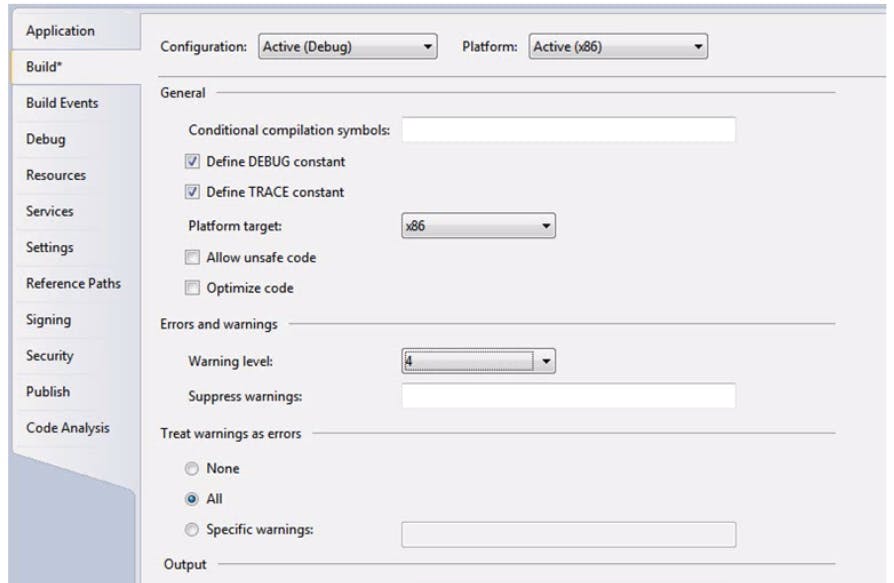
Today's warning is tomorrows error. Developers tend to ignore warnings and sooner or later they turn into errors. It is recommended to enable the setting to treat warnings as errors in visual studio as below
Rule 05: Encapsulate complex expressions
if(account.Balance>0 && !account.IsVIP && account.DueDate > CurrentDate)
{
// do something
}
We encounter expressions like above in every day. This is a maintenance nightmare. Instead encapsulate these expressions into account class as below
if(account.IsPastDue)
{
// do something
}
Rule 04: Try to avoid multiple exit points from method
Instead of returning from various if .. else statements, it is recommended to have one entry and one exit point to every method.
Instead of below code
if(account.Balance<5000){
return false;
}
else if(account.IsPastDue)
{
return false;
}
else if(account.IsVip)
{
return false;
}
return true;
use below code
var isValid=true;
if(account.Balance<5000){
isValid = false;
}
else if(account.IsPastDue)
{
isValid = false;
}
else if(account.IsVip)
{
isValid = false;
}
return isValid;
Above code has only one entry point and one exit point and makes it much more maintainable
Rule 3: Try to avoid comments Comments are mainly used to describe some logic or code. If your code is not self explanatory, refactor and make it meaningful. Comments become stale very quickly and developers tend to forget changing comments whenever they change code. Hence comments not only create maintenance problems but some times can cause confusion if they become stale
Rule 2: Keep methods short If your method is doing too many things, split them. In a general rule of thumb, if the method is having greater than 20 lines of code, it is already too big.
Rule 1: Keep classes short Classes should only do one and only one thing. If you find class doing 2 things, refactor it
➡SQL QUICK REFERENCE - https://lnkd.in/fGMYivX
➡Python for Data analysis - https://lnkd.in/fvKavA2Read More here - https://dzone.com/articles/scrum-guide-2020-beyond-software?edition=642292

Scrum has witnessed many applications beyond its origins of software development over recent years. Being a real framework, Scrum has been augmented by many other practices, techniques, and tools, embracing many of those so tightly that they seem indistinguishable from the framework itself. Or, could you imagine running a Sprint without a Sprint board?
Consequently, the calls for accessibility and inclusion have become louder, and Ken and Jeff managed to answer them compellingly.
I do believe that everyone interested in Scrum as a framework should take an hour and read the Scrum Guide 2020 or the Scrum Guide 2020 Reordered thoroughly. The call for accessibility and inclusion has been heard, and the proposed changes are plenty and far-reaching.
Foremost, the new Scrum Guide is less prescriptive, eliminating many suggestions such as the Daily Scrum questions, at least one mandatory action item from the Retrospective becoming a part of the Sprint Backlog or the advice on why Sprint cancelations are rare events. The Sprint Review lost its detailed recipe on how to run the event. Also, the obvious is no longer stated: Scrum is indeed not trivial to master.
Interestingly, the authors also axed other elements of the 2017 edition of the Scrum Guide that I thought less contested, for example, the magnitude of work allocated to Product Backlog refinement and servant-leadership.
Here are ten changes in the Scrum Guide 2020—in no particular order—I consider remarkable:
As mentioned earlier, there are numerous additional tweaks here and there. To mention a few: The Product Backlog items are no longer estimated but sized, the Scrum Master is no longer removing impediments, but is now “causing the removal of impediments.” Moreover, the “Why is this Sprint valuable?” question has become a part of the Sprint Planning.
Read Full Article here - https://www.leadinganswers.com/2020/11/illuminating-the-intangibles-of-agile.html
Organizations fail when they try to switch to an agile way of working by just implementing the visible agile work practices without the invisible supporting components. They fail because they are missing two key elements:
These factors may sound soft, fuzzy and hard to define, so let’s examine some of the thinking behind them…
1. Psychological Safety
Psychological safety is a subset of emotional intelligence. It is part of working with others and deals with how comfortable we are at interacting, contributing and questioning others at work. In the book The 4 Stages of Psychological Safety, author Timothy Clark outlines a model for understanding psychological safety. As the book title states, it progresses through four stages:
The concepts of inclusion, encouragement, autonomy and “air cover” associated with the four levels of psychological safety play an essential role in the invisible, under-the-waterline support structure of successful agile teams.
Read Full Article here - https://www.leadinganswers.com/2020/11/illuminating-the-intangibles-of-agile.html
Project managers, product owners, scrum masters and team leads establish this psychological safety by modeling the desired behavior. This is done by admitting their mistakes, asking basic questions and generally “learning out loud” to show they do not have all the answers either—and it is okay and encouraged for people to be open.
2. The Agile Mindset and Values
Agile projects apply a different mindset than traditional, predictive approaches. Predictive projects work from the idea that things can be specified upfront, and the role of the project manager is to break down the work into simpler and simpler steps until they can be handed out to team members. For predictive projects, the mantra “plan the work, work the plan” applies.
Agile projects believe the team is best positioned to co-design and co-create the solution in collaboration with the business. There is no complete upfront design; instead, it emerges through exploration and use. If agile projects had a corresponding mantra, it would contain words such as “incrementally build the highest value solution via collaboration in empowered teams.”
So, predictive projects use design followed by build with centralized coordination, while agile projects use design and build in parallel with distributed coordination.
One approach is not necessarily better than the other. Projects and programs often combine work that suits both systems. The role of the modern project manager involves being fluent in each approach and knowing when and how to implement them.
However, returning to our theme of illuminating some of the agile mindset values, both the mindset and values build on from psychological safety. They include ideas such as:
In the book Collaboration Explained, author Jean Tabaka explains that collaborative teams have the following properties:
These characteristics can be evaluated at a retrospective through anonymous surveys. The image below shows data gathered from six team members on a range of 1-5 on each of the eight collaboration factors:
We can use tools such as this—and an understanding of psychological safety—to determine if we have the requisite elements in place for an agile approach to be successful.
Agile adoption can be hindered by the sometimes-foreign language used in agile approaches. Yet ideas from Scrum and XP (such as transparency and courage) are just instances of psychological safety that we can trace to “working with others” in emotional intelligence.
Likewise, collaboration—the secret sauce of effective agile teams—can be tracked to buy-in for specific attributes. These include being self-organizing, being empowered to make decisions, having a belief in the vision, being consensus-driven, trusting each other and having constructive disagreements. No easy feat, but not mystical or unobtainable, either.
Summary
Read More here - https://www.leadinganswers.com/2020/11/illuminating-the-intangibles-of-agile.html


Created with by BeautyTemplates | Distributed by blogger templates

 Posts

