Powered by Blogger.
🌏World roaming Software Technology Evangelist. Proud Indian, Bought up from Coimbatore, Tamilnadu, INDIA. Pointing towards share of Knowledge. 😎
  • Programming ▼
    • DotNet
      • C# Coding Standards
    • Cloud
    • Microsoft 365/ SharePoint
    • SQL
    • Angular / ReactJS / NodeJS
    • Salesforce
    • Magento
    • Python
    • Mobile App Development
    • Database
    • DevOps
    • Automation Testing
    • User Experience
  • Learning ▼
    • Roadmap
    • Trainings
    • E-Books
    • Quick References
    • Certifications
    • Self Improvement
    • Productivity
    • TED Talks
    • Kids Programming
  • SW Engineering ▼
    • Agile
    • Software Design
    • Architecture Samples
    • Best Practises
    • Technologies and Tools
    • Open Sources
    • Free Softwares
  • Leadership ▼
    • Program Management
    • Product Management
    • Project Management
    • People Management
  • Job Search ▼
    • Interview Tips
    • Career Handbook
    • Resume Templates
    • Sample Profiles
    • Cover Letter Samples
    • HR Interview Questions
    • Job Websites List
    • Coding Site Links
    • TedEx Talks
    • International Jobs
  • Emerging ▼
    • Innovation
    • Machine Learning
    • Artificial Intelligence
    • Generative AI
    • AI Tools
    • Big Data
    • Data Science
    • Data Analytics & Visualization
    • Cyber Security
    • Microsoft Azure
    • Amazon Web Services
    • Cryptography
    • ChatBots
    • Internet of Things (IoT)
    • Mixed Reality /AR/VR
  • Misc. ▼
    • Travel
    • Photography
    • Health Tips
    • Medical Tips
    • Home Designs
    • Gardening
  • Samples ▼
    • GitHub
    • Executive Dashboard
    • Chatbot
    • Image Generator
    • Jay's Link Tree
  • Favourites▼
    • Saran Kitchen Hut
    • World of Akshu
    • Saran & Akshu - Other Links
Referred Link - https://www.linkedin.com/pulse/iot-blockchain-artificial-intelligence-new-holy-trinity-mohit-agrawal/


Internet of Things (IoT), Blockchain and Artificial Intelligence (AI) are the buzz words that everyone seems to talk about. All three technologies are at peak of inflated expectations as per Gartner Hype Cycle for emerging technologies (Please refer to the chart on the right). The time to maturity is roughly the same for the three technologies though Blockchain may take a little longer.


Each of these technologies have immense potential and are rightly getting all the attention. However, if we take these technologies together, we are taking about an explosive multiplier effect. I can already see a potent trinity of IoT, Blockchain and AI taking shape in coming years.

IOT & BLOCKCHAIN

My earlier article on Business Models for IoT got several comments from the readers about security, trust and smart decisions. A few comments were also about the true differentiation of IoT from other enterprise-wide large IT implementations. I had written the the IoT business model article two years back when the Blockchain technology was still in infancy (to be honest, I did not have much idea about it then). Now, I can clearly see the benefits of using Blockchain technology along with IoT platform.
What is Blockchain? Blockchain is a digitized, decentralized ledger of all transactions. The transactions are replicated across multiple computers and linked to each other to make any tempering with records virtually impossible. This immutable way of managing records eliminate the need for any central entity managing the transactions. Blockchain should not be confused with the bitcoins. Blockchain is the platform while bitcoin is just one of the many applications that uses Blockchain platform just the way internet is to email. Click here quick tutorial on Blockchain.

BENEFITS OF USING BLOCKCHAIN PLATFORM WITH IOT

  1. Trust – Blockchain’s decentralized, open & cryptographic nature allows people to trust each other and transact peer to peer. As autonomous systems and devices interact with each other, the IoT transactions are exposed to potential security risk. Blockchain technology gives a simple, cost-effective, and permanent record of decisions made and communicated.
  2. Traceability– Data transactions take place between multiple networks owned and administered by multiple organizations. Blockchain can provide a permanent, immutable record so that custodianship can be tracked when data or physical goods, move between points in the value chain. Blockchain records are by their very nature transparent – activity can be tracked and analyzed by anyone authorized to connect to the network.
  3. Security – Security is a holy grail of IoT networks and is one of the biggest concern. Imagine a scenario where the hackers are able to attack the smart city network thereby not only bringing down all the interconnected processes but also exposing the personal data. If the data is exchanged over Blockchain network, the overall security of the IoT network is greatly enhanced.
  4. Smart Contracts – Blockchain have smart applications or contracts that get automatically executed when the conditions are fulfilled. Using smart contracts, the actions can be executed across various entities in the supply chain automatically in an immutable manner without worrying about the disputes.

EXAMPLES OF USING IOT WITH BLOCKCHAIN

The usage of IoT with Blockchain is already gaining momentum. IBM’s Watson IoT platform integrates well with Blockchain (backed by Hyperledger Fabric) effectively combining the two technologies. Similarly, Azure IoT also has good integration with Ethereum, Corda and Hyperledger Fabric. Below are some of the examples of using Blockchain in conjunction with IoT :
  • Blockchain can be used to record and timestamp the sensor data. This way the data from the sensors would not be manipulated and can be trusted by all the parties in the transaction. In Smart Cities, multiple entities are collecting and acting on data. The data can be trusted easily by use of Blockchains. Use of Blockchain in Smart City can even enable the citizens/entities to sell their data and get paid via bitcoins.
  • IoT has multiple devices and the devices are authenticated based on digital certificates rendering the devices vulnerable to security breaches. Blockchain can create the digital identity of the devices so that they cannot be manipulated. Also, the information about the devices can be dynamically updated leading to higher scalability.
  • Provenance of a product can be established using IoT and Blockchain. IoT sensors can be placed on the medicine packets. The sensors can trace and record as the medicine packets move from the factory to the distributor to the retailers using the distributed ledger of Blockchain. IoT sensors with Blockchain can go a long way in getting around the problem of fake medicines in many of the emerging markets.
The Blockchain technology is still in infancy with a few drawbacks that would take some time to resolve but the technology is here is to stay. The biggest drawback is the speed of transactions. Currently, transactions throughput in Blockchains is very limited. As a result, the costs are still high and the full benefit of removing the middleman is yet to be realized. Efforts are underway to increase the transactions throughput.

ARTIFICIAL INTELLIGENCE AND IOT

In earlier times, codes were written and machines would perform as per the software code. The machines brought productivity gains by making processes efficient but failed to do things that they were not coded for. Humans know more than what they can train others and for this very reason machines could never compete with humans in the past. However, now with artificial intelligence and deep learning, it is possible to train machines by making them experience different situations. The algorithms get better with time. This is a revolution and can be effectively used in IoT. IoT means a lot of data. With help of AI, IoT platforms can get the ability to recognize meaningful patterns buried in mountains of data and take decisions difficult even for humans.
IoT platforms are already using machine language which is a sub set of Artificial Intelligence. With full fledged Artificial Intelligence, IoT platforms would be akin to being on steroids. To achieve the full benefit of IoT, not only the speed of analysis is important but also the accuracy of analysis. The decisions made by IoT platforms would get better over time as the AI platform learns with experience.
Predictive maintenance is an area of interest to many manufacturers. The endeavor is always to cut down on the downtime, increase machine availability without increasing expenditure on maintenance. SK Innovation, a leading South Korean oil refiner, is using artificial intelligence to predict the failure of connected compressors. AI based systems have helped save Google 40% of data centers cooling costs by predicting the temperature and pressure thereby limiting the energy usage. All major IoT platforms like Azure IoT, AWS IoT, etc. now have machine learning for predictive capabilities already incorporated but going forward the deep learning capabilities would become more commonplace.

IOT, BLOCKCHAIN & AI IN ACTION – PUTTING IT ALL TOGETHER

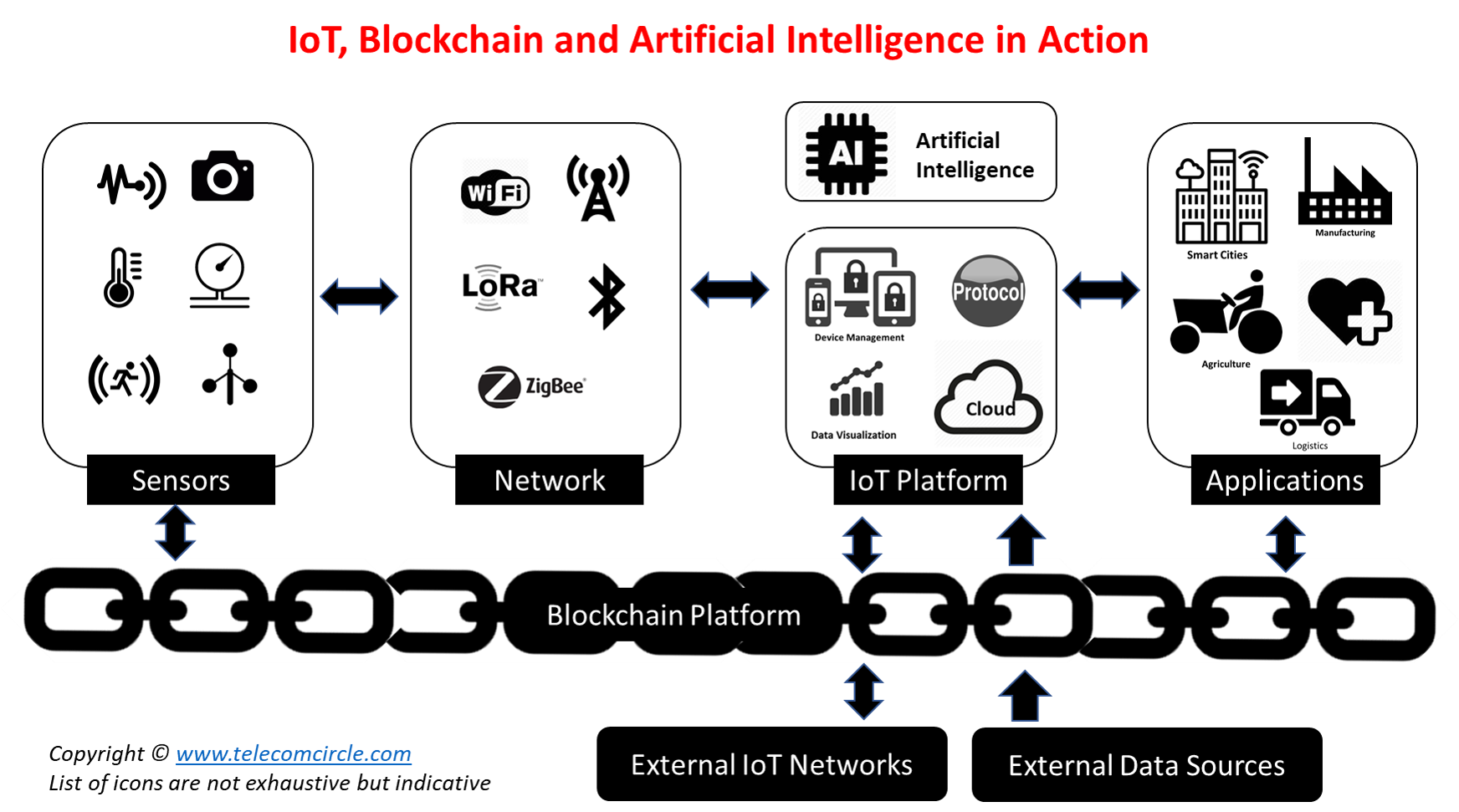
Below is the visual representation of how the three technologies work in tandem with each other. The diagram is a little simplistic as the processes with not happen in parallel all the time and there would be overlaps.

Artificial Intelligence gets layered over the IoT platform while the data from external sources flows through the Blockchain platform. Even the data exchange within the IoT network can happen over Blockchain to ensure traceability and recording of all transactions. Multiple IoT networks can exchange data while the power of AI will get exponentially enhanced with more data. The trinity of these technologies will not only help increase efficiency but also help businesses deliver better customer service.
The trinity is not without its drawbacks. Using the three technologies together would lead to higher complexity while the privacy issues would continue to haunt a number of business and consumer applications. There would be challenges around compatibility due to lack of protocols and standards. Some of the applications are likely to charter in untested territories and may face legal or lack of legal challenges.

SUMMARY

IoT, AI and Blockchain can complement each other well and can potentially remove some of the drawbacks of these technologies when implemented in isolation. The idea of these technologies working in tandem is not new but in my opinion the convergence would happen faster than predicted. We need to stretch our minds to fully envision the impact of these three technologies taken together. The technologies have long been driven by the brilliance of technology folks. Now is the time for visionary business people to wake up to the potential of this trinity and start to look at creative ways of using them for appropriate solutions. The limitation is not going to be the technology solutions but the imagination of the business leaders.
This six-minute video is all you need to understand why everyone is talking about "Blockchain" Now you know!


https://dms.licdn.com/playback/C5605AQFV6pEVo62kWw/2632b76b93aa4098af25651770af1d27/feedshare-mp4_500/1479932728445-v0ch3x?e=1522126800&v=alpha&t=pDJTcVGDSG0gWvK_2EtY7xHz1WkznsvIjTmOlIBmIxI
Referred Link - http://www.aexonic.com/peak-into-our-mind/blockchain-iot-can-together-bring-us-bigger-benefits/


Blockchain and IoT have now become an important aspect of every growing business you see around. The network of IoT devices has been growing exponentially since the past year or so, and with the combination of Blockchain, that holds the power to disrupt any business, the amalgamation of both is sure to bring us a bag of innovative surprises.
To understand the convergence better, let us go through some points that explain how the two technologies can together bring us bigger benefits.
  • Blockchain is the missing link to bring privacy, security and reliability to the IoT network of devices
  • Blockchain can be used to track billions of connected IoT devices that help in better coordination and processing of transactions
  • As Blockchain is a decentralized system, it would eliminate any single points of failure and in the process create a more resilient and sustainable environment for the devices to run
  • As the data in blockchain can be encrypted by the use of cryptographic algorithms, it will make the consumer data stored or coming in from the IoT devices safe and private
  • In a network of billions of connected IoT devices, blockchain can keep an immutable record of the history of connected devices which helps in the autonomous functioning of the devices without any centralized control.
  • The ledger that stores data in the blockchain network is tamper-proof which means it cannot be manipulated by unwanted, malicious agents.
  • Blockchain has given a push to Industrial IoT or IIOT which is essential in large organizations which hold millions of sensitive data and carries out hundreds of transactions each day.
To sum up the basic advantage of using Blockchain for IoT –
  1. Building Trust between the devices and the parties involved, thereby reducing the risk of any fraudulent behaviour
  2. As it removes the third parties and intermediaries involved, it removes any cost that is related to them
  3. It makes the transactions quickly and securely, reducing the settlement time from few days to almost instantaneously.
The decentralized, autonomous and secure platform of a Blockchain network makes it an ideal component to be a fundamental part of IoT solutions. We have companies who have adopted the same and are running successfully ever since. However, there are few challenges they face in the process too. Let us have a look at them.
  • Operational Challenges – This business model requires many agreements and parties involved, especially in a broader ecosystem. There is also storage issue as the ledger’s size needs to be increased with time. Encryption and cryptographic algorithms on the huge amount of data will require a lot of processing power and time too.
  • Legal Challenges – This convergence is new and there needs to be someone to look into cases where actions that are taken by devices on the basis of a rule that is automatically executed by a blockchain-based application or Smart Contracts, triggered by another similar application. This is a complex scenario but can very well come up with the heavy use of blockchain based IoT network.
Referred Link - http://www.aexonic.com/peak-into-our-mind/blockchain-applications-use-cases/


Blockchain has been one of the most talked about technologies in 2017. There are a lot of research happening to identify how this technology can transform various applications and operations we encounter in our daily lives. There is absolutely no doubt about the fact that blockchain holds a lot of power to disrupt the way we see things around us.
As we begin to analyze the various applications and use cases blockchain can be used for, beyond Bitcoin of course, we need to understand the various benefits it brings to any business. Let us have a quick recap of its advantages from our previous blog – What is Blockchain Technology? A Quick Guide to understand it better.
  • The peer-peer network removes any third party intermediaries like banks etc
  • The consensus, approval and the verify processes happen in real-time which ensures faster transactions
  • Every involved participant has the access to the information stored in blockchain and no alteration can be done without the consent of them. This brings trust and transparency in the entire system
  • As the distributed ledger systems are decentralized, they provide faster ROI and help businesses create a better business model that brings them more profits
  • Blockchain network is highly secure and impossible to hack. This reduces any fraudulent activity to take place and promises to bring a reliable business platform to ensure productive business activities
  • Blockchain’s algorithms are programmable and can be used to automate systems on the basis of prior terms and conditions
So, what are the different ways Blockchain can be used for?
As a Record
  • Blockchain can be used to create a strong system for digital identity with the help of cryptographic keys
  • As tokens, it can be used for authenticating physical items, proving useful in supply chains, fraud management and intellectual property management
  • It helps in inter-organizational data management keeping an organized system of records especially the sensitive ones
Financial Institutions
  • Blockchain can be very useful in audit trails
  • It provides a more secure platform for transactions as it let goes any third party mediation keeping the key account information secure
  • It can help settlement happen between the two parties almost instantly rather than the normal 2-3 days
Supply Chain
  • Blockchain can be used to track down any information regarding the product – where and how it has come to the end user
  • With the help of Smart Contracts management of these data will be easier and more secure
Real Estate
  • The information can be stored securely and can be tracked down without the involvement of any intermediaries
  • With a secure platform, the corruption and fraudulent activities can be nullified
Insurance
  • Blockchain offers Minimization of Identity Theft and Limitation of Cyber Liability for insurance industry
  • Decentralized Data Repository bring better Security for the companies and also help in the management of huge data
Healthcare
  • Medical insurance and claims involve a lot of transactions every second. Blockchain can reduce process time and friction while dealing with compliance with contract terms.
  • Healthcare has numerous data flowing in its environment. Patients personal details, medical history, advance medical records and much more and this technology can help them manage it better
These are just a few applications where this technology has proven to be very useful. 2018 can be the year where more blockchain use cases come up and surprise us with its unique application. 
Referred Link - https://www.linkedin.com/pulse/difference-between-public-private-blockchain-abhishek-prasad


While we try to understand Blockchain better, it is very important to understand how its two major network types work and what advantages do they bring to our business. Each type has its own set of benefits which is why it is important to analyze them and use the best one for our business.
Before we get into how different Public and Private Blockchain, let us have a look at some of their similarities.
  • Both are decentralized peer-peer networks and every participant involved in the transaction maintains a copy of the same.
  • Through a protocol referred to as consensus, both networks maintain the replica of transactions and are in sync with each other. This means any change or addition made on the transaction information will be immediately reported to the other party.
  • A certain level of security is maintained by both the networks

So, what is the difference?

The primary difference between the public and private blockchain networks is the participants who are allowed to be a part of the network and maintain the shared ledger.
Public Blockchain is completely open and anybody can join and be a part of the network. It has an incentivizing mechanism that encourages more and more people to participate in the network. Private Blockchain gives a little bit authority to the firm or organization that controls the network. Only a certain individuals can be a part of it who qualify a set of terms and condition and it’s the company that controls who can read access to their transactions. This brings a level of privacy in private networks which the public networks lack.
A major drawback of public blockchain networks is that it involves a good deal of computational power which is a necessity as the distributed ledger needs to be maintained on a large scale. The consensus process is also a little more intense and the whole process results in a little more costly affair than the private networks.
Public blockchain has low transactional speed owing to the huge pile of data that needs to be processed to complete the transaction. Private networks, however, initiate the transactions quickly, as the parties involved have an inbuilt trust, the network nodes are well connected, which is why the consensus happens a lot more quickly. This makes them an efficient system which a lot of traditional business and governance model are eying upon.
The immense potential and accelerated growth that blockchain has brought to the tech-world are highly remarkable. The added interest from a wide range of industries across various sectors is a stimulant in the entire process which makes us believe that Blockchain is indeed the technology of future.
Originally featured on Blog from Aexonic.
Referred Link - https://www.linkedin.com/pulse/enterprise-guide-blockchain-abhishek-prasad


The blockchain is undeniably one of the most trending technologies at the moment. Originally devised for the digital currency – Bitcoins, Blockchain has expanded its dimensions and now holds the potential to disrupt the way a business operates – in any sector.
While it is still believed to have a lot of unidentified potentials, it has become important for every tech-enthusiast and even business firms, to understand what it is, how it operates and how can it bring a difference to their business. In this article, we shall try to explain the same.

Blockchain and Distributed Ledger – What are they?

In simple terms – Blockchain is an incorruptible and immutable digital ledger that holds the records of every transaction.
Distributed Ledger is a simple database of transactions that securely records the information across a peer-peer network. The transactions are shared and synchronized across several computers and locations without any centralized control.
The parties involved in the transaction own an identical copy of the record, which is updated in real-time if any additions are made.

What are Smart Contracts?

Smart Contracts are self-executing contracts that help a transaction to take place without the involvement of a third party or middlemen. They are programmed in such a way that they trigger payments or any other relevant action as soon as the proposed conditions are met. Real-Time information like the asset GPS data are examples of triggers that initiate a transaction.

How does Blockchain work?

A Blockchain stores data in nodes that are immutable once stored. When a transaction happens between a peer-peer network, the data is recorded and each participant is able to review the entry and approve, reject or verify depending upon the information available. Once approved, the data is stored in blocks or nodes that are stored in chronological order – or chain and cannot be altered with the consent of all the participant involved.

What are the different types of Blockchain networks?

There are 4 types of Blockchain network available as of now.
  • Consortium Blockchain – This is presently the most popular form to establish a blockchain network. In this, the approval of information is controlled by a previously selected party or individuals – a group of corporations for example.
  • Semi-Private Blockchain – These networks are run by a single company that allows access to a transaction to individuals who have cleared the terms and condition to be eligible for the same. This is gaining popularity in the B2B market.
  • Private Blockchain – They are 100% centralized and private networks that are controlled by a single organization and hold the power to control who reads or participates in a transaction.
  • Public Blockchain – The information is public and anybody can read or participate in the approval process. Although users can opt to be anonymous, the details are public and anybody can be a part of it. Bitcoin is an example of the same.

Benefits of Blockchain

The potential of blockchain in now in open and so is the plethora of benefits it brings along with itself. Let us have a look at some of them.
  • The peer-peer network removes any third party intermediaries like banks etc
  • The consensus, approval and the verify processes happen in real-time which ensures faster transactions
  • Every involved participant has the access to the information stored in blockchain and no alteration can be done without the consent of them. This brings trust and transparency to the entire system
  • As the distributed ledger systems are decentralized, they provide faster ROI and help businesses create a better business model that brings them more profits
  • The networks are highly secure and impossible to hack. This reduces any fraudulent activity to take place and promises to bring a reliable business platform to ensure productive business activities
  • Blockchain’s algorithms are programmable and can be used to automate systems on the basis of prior terms and conditions

Some of Blockchain Use Cases

As blockchain are becoming more and more popular, different business sectors are trying the accept this technology and make the most of it.
  • Financial Services – With blockchain, the security of asset or money transaction can never be compromised and money transaction can be held more securely.
  • Voting – With the introduction of this technology, audit trail of election’s votes can help track the voter’s identity store the data securely.
  • Supply Chain – Blockchain can help to easily track down any information regarding the product – where and how it has come to the end user. W the help of Smart Contracts management of these data will be easier and more secure.
  • Real Estate – The real-estate industry involves a great deal of paperwork and in-out transactions. With the help of this technology, the information can be stored securely and can be tracked down without the involvement of any intermediaries.
  • Utilities – Peer-to-Peer energy trading among utility conglomerates, automated billing for autonomous electric vehicle, solar energy etc can be benefitted with help of Blockchain
I am excited to see what this technology will bring to us in 2018. I hope this article gives you an idea of what it is and how your business can benefit with this.
This article was originally published at Aexonic Blog
Source - https://yourstory.com/2017/11/blockchain-bitcoin-artificial-intelligence-1-0-need-know/

Blockchain, Bitcoin and Artificial Intelligence may be buzzwords, but it’s important for corporates, startups, and individuals to make sense of these technologies of the future.
A startup founder comes up and says, “I invested Rs 40,000 in Bitcoin; it has now doubled.”
Two days later, a friend says, “I want to invest my savings in Bitcoin.”
This is followed by an engineer, asking: “Will artificial intelligence take away my job?”
There is a lot of science fiction in parallel to realities that encompass Blockchain, Bitcoin and Artificial Intelligence.
But SBI’s Head of Innovation Sudhin Baraokar says it as it is. “These technologies are at a juncture where the internet was 20 years ago. The understanding is still minimal for businesses and corporates,” he says.


Now instead of going into theories, let us look at the history of these technologies and how they will impact you.

From Blockchain to Bitcoin

Bitcoin, a crypto-currency, was born 10 years ago when the founder, Satoshi Nakamoto, who has not revealed himself to the world as yet, wrote a technology protocol called Blockchain. This technology protocol works on distributed networks where it creates blocks out of information (ledger entries) passing through a transaction between multiple parties. This information cannot be tampered by any party because everyone can access the information at the same time. Information cannot be changed without the other knowing.

How this works

Current digital technology is based on client-server models where information that is updated or exchanged is controlled by one central server and database. In a business contract execution between two parties, the information is always passing through a bank, which is a trusted third party.
In a Blockchain, the system works differently. It works on distributed computing where every bit of information updated between multiple parties is captured by all parties, including the bank. There is not one central server controlling the flow of information updates; this does not complicate or duplicate work.
“There is no gatekeeper in this case since information flow is open and the third party is a facilitator who witnesses a transaction for you rather than executing it on the behalf of two parties and there is digital trust,” says Sudhin, of SBI. He adds that this digital trust is added by multiple parties coming together to make a system come true.
In simple terms, authorisation and authenticity of the transacting parties cannot be manipulated. At least in theory.
Your Story has reported what Blockchain can do for smart contracts and how it can help your business (read here).
That is Blockchain for you. But, what of Bitcoin?
Bitcoin, which is not a physical entity or organisation, is a deregulated currency that wants to create a new world order in the financial system. It enables a peer-to-peer transaction, where no bank exists in the exchange of goods and digital currency. The whole system is not regulated by central banks of the world, which for the last 200 years have decided the value to an item of exchange either pegged to gold or to the dollar based on trade deficits of nations. The PWC image tells you everything about this technology.
Image Courtesy PWC
Let us consider an example involving the sale of bananas under the bitcoin system before explaining the tech.
Farmer Vineet Kumar wants to sell 1 ton of bananas to Joe Maggio in the Philippines and they both get into a contract digitally. But, the Blockchain network will set the price based on agri transactions happening across the world. Now, this is where the technology kicks in that a certain individual called Vineet has agreed to sell bananas to Joe at a certain value of Bitcoin.
Once a smart contract is executed by all parties – the logistics firm, the customs and the shipping company – the Bitcoin is released between all parties. How is the question?

The Bitcoin tech

This smart contract becomes a block in the system, which the technology verifies to be true within all parties. Since it is a distributed open loop ledger system, the computer that first verifies the transaction mines bitcoins and facilitates the exchange of goods between both parties.
Rajesh Dhuddu, SVP at Quatro, a company that advises on Blockchain technology, says, “This financial and payment system is not understood by many as yet and only smart contracts are understood so far.”
He adds that the Bitcoin scenario remains a financial system understood by a few. Those who have Bitcoin have ushered in an investment frenzy of late because the price of one Bitcoin today is Rs 5.36 lakh. But if you don’t understand the system, it’s advisable not to speculate. Bet on companies that are building smart contracts through Blockchain; Bitcoin speculation is completely dependent on how nation-states will react to this borderless currency.
For the Bitcoin system to become mainstream, it requires central banking to disappear and money as a concept to completely be controlled by a digital system without factoring in data such as inflation and consumer price index. Will it end poverty? No!
“It will be used by advanced societies and the world will have both Bitcoin and currency,” says Arifa Khan, a representative of Etherium Foundation, a technology protocol for Blockchain. She says Bitcoin works because it does not need banks controlling the exchange of goods between people.
Nonetheless, the narratives of the financial system will still create a world of the haves and have-nots.
Let us explore why as we see artificial intelligence step into the scenarios discussed above. AI technically sits on top of Blockchain, can crunch massive amounts of data and make decisions at the same time.

The rise of Artificial Intelligence

Artificial intelligence is software that writes itself and learns from massive data patterns to make decisions. Today, all software is still being taught by humans and is in the realm of machine learning and deep learning. While governments and politicians use the word AI, they want to jump into the narrative because they can get more students to register in colleges and remain relevant in elections. Nonetheless, the lack of jobs will also be part of their political shenanigans.
In essence, 20 years from now there can be several possibilities. You don’t need people in an era of AI to program systems. Job losses will be real unless corporates train individuals to train the system. This is where society must realign its entire talent to be productive to do something else because consumption is what drives the current financial and economic system.
Author Yuval Noah Harari, in his book Homodeus, says there will be a large useless class who will be dominated by superhumans with implants to power the brain and also live longer. This a possibility and not a prophecy. However, books apart, corporates are already investing in AI.
“If the client wants efficiency we have to move towards systems and technologies that make work happen in the most efficient way in terms of service and price. AI allows that,” says NS Parthasarathy, EVC at Mindtree. He adds that the future is about answering what clients demand.
So, if you are worried about Blockchain, Bitcoin and AI, don’t be because they are all going to impact us at some point. It’s time to learn about these technologies of the future! But refer to the image from PWC and it can help you understand it better.
Referred Link - https://www.linkedin.com/pulse/please-tell-me-what-blockchain-how-does-work-peter-van-emst

(C) Peter van Emst


People ask me frequently, “Please tell me, what is blockchain and how does it work?” I have been using various approaches and media answering this question, whiteboards, paper and even beer-coasters, and recently created a single page canvas combining all my scribbles and drawings to answer this question. This works very well, with great response and I like to share it including the story that goes with it. Maybe it is somewhat technical but most people follow the explanation quite well and really feel that they have learned something. Re-use is granted, but please keep it “as is” and respect the copyrights. (See below for downloads, OpenOffice and PDF format)
Doing business and transactions between organizations and people requires TRUST. Normally we do not think about this but every day we pay our invoices or buy goods with a debit- or credit card, issued by a bank or credit card company who guarantees these payments. These so called middleman are initiated, regulated and audited by governments giving us the required trust. But what if you could arrange this via technology providing us with the same guarantees as a middleman but without the middleman. This is where blockchain can help us, providing a mechanism to do business without knowing your counter party or their reputation. First used for Bitcoin transactions (crypto-currency) but suitable for any other transaction or contract that we want to register in an immutable and secure manner. Think about registering land property, music rights or mortgages.
In a typical blockchain we recognize four important elements: the hash, the block, the nonce and the consensus model. How does this work?
First let me explain hashing, a key-element in blockchain. Hashing is a mathematical function that converts an arbitrary text into a fixed length digital key. This process is irreversible, every key produced is unique and even the slightest change in the input generates a completely different key. (Observe the W and w difference). This key, also called the HASH, can be seen as the unique signature or fingerprint of that piece of text or information. (FYI: Hash functions are designed by the United States National Security Agency (NSA) and made available under a royalty-free license.)
Next, let's have a look at a block and its structure in a simplified model. We distinguish two main parts: the heading of the block with housekeeping details and a section containing the transactions. (In this example you see a set of simple financial transactions, but any transaction can be included.) The housekeeping section is especially important as it is used to link the new block with previous blocks. Within the heading we see several fields and most are pretty straight forward; version info, time stamp and a copy of the previous block Hash. To secure that the transactions in the block itself are fingerprinted in an irreversible way, a “Transactions Hash” is generated from all entries with the above explained algorithm and added into the header. The information of all these header-fields is then used to generate the Hash, or signature of the block.
So why do we include a NONCE in the header?
Creating a signature of a new block is pretty straight forward but makes it also vulnerable for anyone who wants to tamper with its content. Calculating a hash is a matter of milliseconds, so changing a transaction and creating a new hash is very easy, too easy and therefore not 100% secure. We can prevent this by demanding that the Hash of a block starts with leading zeroes which is only possible if we change the input for the hash calculation. This is where the Nonce (Number Once) comes into play, every time we change its value a different hash is generated. Verifying all possibilities requires serious compute power/time and that makes it unattractive to tamper with the transactions in the new and all depending previous blocks. This process is known as - “the mining of a block”, providing us with the security that transactions are "written in stone and immutable". Mining - especially of crypto-currency - is financially very profitable and more compute power is added on daily basis. To deal with this, the number of leading zeroes is regularly adjusted to balance the increase in compute power. (FYI: Mining reward for the Bitcoin Blockchain is currently 12,5 BtC per block).
Once the right Hash is found, the newly mined block is presented to the network of “fellow” miners for approval and consensus. Typically six fellows have to confirm that the block is correct after which it is added to the chain. This consensus cycle is another security mechanism adding to the robustness of a blockchain. The process repeats itself and the hash of the recently added block is used as input to mine the next block resulting in a chain of blocks. Impossible to alter without changing the previous block, and the previous block, and the previous block.....
Blockchain offers us an highly effective means to organize the need for trust in a different way, secure and clean on a global basis, robust and transparent with no/limited overhead.
Downloads:
https://www.slideshare.net/PetervanEmst/blockchain-mechanics-odf-format
https://www.slideshare.net/PetervanEmst/blockchain-mechanics-pdf-format
References:
  • https://en.bitcoin.it/wiki/Mining
  • https://en.bitcoin.it/wiki/Hashcash
  • https://en.wikipedia.org/wiki/SHA-2
More info:
  • https://www.youtube.com/watch?v=lik9aaFIsl4
  • https://anders.com/blockchain/
Older Posts

Total Posts

Search this Site

Connect with Me

Translate Articles

Total Pageviews


Contributors

My photo
Jayavel Chakravarthy Srinivasan
Professional:I'm a Software Techie, Specialized in Microsoft technologies. Worked in CMM Level 5 organizations like EPAM, KPMG, Bosch, Honeywell, ValueLabs, Capgemini and HCL. I have done freelancing. My interests are Software Development, Graphics design and Photography.
Certifications:I hold PMP, SAFe 6, CSPO, CSM, Six Sigma Green Belt, Microsoft and CCNA Certifications.
Academic:All my schooling life was spent in Coimbatore and I have good friends for life. I completed my post graduate in computers(MCA). Plus a lot of self learning, inspirations and perspiration are the ingredients of the person what i am now.
Personal Life:I am a simple person and proud son of Coimbatore. I studied and grew up there. My mom and wife are proud home-makers and greatest cook on earth. My kiddo in her junior school.
Finally:I am a film buff and like to travel a lot. I visited 3 countries - United States of America, Norway and United Kingdom. I believe in honesty after learning a lot of lessons the hard way around. I love to read books & articles, Definitely not journals. :)
View my complete profile

My Achievements

My Achievements

My Favorite Links

  • Saran & Akshu Links
  • Saran Kitchen Hut
  • World of Akshu
  • Ashok Raja Blog

Subscribe To

Posts
Atom
Posts
All Comments
Atom
All Comments

Contact Form

Name

Email *

Message *

Blog Archive

  • ▼  2026 (34)
    • ▼  July (1)
      • AI Hackathon - July 2026 - Guinness World Record A...
    • ►  June (6)
    • ►  May (7)
    • ►  April (7)
    • ►  March (7)
    • ►  February (5)
    • ►  January (1)
  • ►  2025 (65)
    • ►  December (4)
    • ►  November (3)
    • ►  October (3)
    • ►  August (1)
    • ►  July (6)
    • ►  June (7)
    • ►  May (26)
    • ►  April (1)
    • ►  March (3)
    • ►  February (1)
    • ►  January (10)
  • ►  2024 (134)
    • ►  December (3)
    • ►  November (8)
    • ►  October (11)
    • ►  September (2)
    • ►  August (1)
    • ►  July (39)
    • ►  June (8)
    • ►  May (4)
    • ►  April (9)
    • ►  March (6)
    • ►  February (33)
    • ►  January (10)
  • ►  2023 (16)
    • ►  December (12)
    • ►  August (2)
    • ►  March (1)
    • ►  January (1)
  • ►  2022 (14)
    • ►  December (1)
    • ►  August (6)
    • ►  July (3)
    • ►  June (2)
    • ►  February (1)
    • ►  January (1)
  • ►  2021 (16)
    • ►  December (1)
    • ►  November (2)
    • ►  October (2)
    • ►  August (1)
    • ►  July (2)
    • ►  June (2)
    • ►  May (2)
    • ►  March (2)
    • ►  February (1)
    • ►  January (1)
  • ►  2020 (36)
    • ►  December (1)
    • ►  November (15)
    • ►  October (2)
    • ►  September (1)
    • ►  July (1)
    • ►  June (2)
    • ►  May (4)
    • ►  March (2)
    • ►  February (6)
    • ►  January (2)
  • ►  2019 (14)
    • ►  December (3)
    • ►  November (1)
    • ►  September (2)
    • ►  August (1)
    • ►  June (1)
    • ►  May (3)
    • ►  March (2)
    • ►  January (1)
  • ►  2018 (61)
    • ►  November (3)
    • ►  October (4)
    • ►  September (4)
    • ►  August (5)
    • ►  July (4)
    • ►  June (4)
    • ►  May (7)
    • ►  April (7)
    • ►  March (5)
    • ►  February (1)
    • ►  January (17)
  • ►  2017 (55)
    • ►  December (1)
    • ►  November (7)
    • ►  October (7)
    • ►  September (8)
    • ►  July (4)
    • ►  June (7)
    • ►  May (4)
    • ►  April (4)
    • ►  March (1)
    • ►  February (2)
    • ►  January (10)
  • ►  2016 (45)
    • ►  December (1)
    • ►  November (5)
    • ►  October (2)
    • ►  September (7)
    • ►  August (3)
    • ►  July (3)
    • ►  June (1)
    • ►  May (3)
    • ►  April (5)
    • ►  March (3)
    • ►  February (3)
    • ►  January (9)
  • ►  2015 (88)
    • ►  December (5)
    • ►  November (2)
    • ►  October (6)
    • ►  September (6)
    • ►  August (3)
    • ►  July (6)
    • ►  June (7)
    • ►  May (12)
    • ►  April (6)
    • ►  March (11)
    • ►  February (10)
    • ►  January (14)
  • ►  2014 (159)
    • ►  December (16)
    • ►  November (13)
    • ►  October (42)
    • ►  September (12)
    • ►  August (19)
    • ►  July (3)
    • ►  June (17)
    • ►  May (10)
    • ►  April (12)
    • ►  March (7)
    • ►  February (4)
    • ►  January (4)
  • ►  2013 (192)
    • ►  December (7)
    • ►  November (2)
    • ►  October (3)
    • ►  September (10)
    • ►  August (25)
    • ►  July (17)
    • ►  June (22)
    • ►  May (22)
    • ►  April (24)
    • ►  March (17)
    • ►  February (22)
    • ►  January (21)
  • ►  2012 (204)
    • ►  December (21)
    • ►  November (35)
    • ►  October (47)
    • ►  September (27)
    • ►  August (6)
    • ►  July (21)
    • ►  June (16)
    • ►  May (7)
    • ►  April (9)
    • ►  March (4)
    • ►  February (3)
    • ►  January (8)
  • ►  2011 (70)
    • ►  December (8)
    • ►  November (5)
    • ►  October (3)
    • ►  September (2)
    • ►  August (7)
    • ►  July (3)
    • ►  June (30)
    • ►  May (3)
    • ►  April (3)
    • ►  March (1)
    • ►  February (3)
    • ►  January (2)
  • ►  2010 (30)
    • ►  December (1)
    • ►  September (4)
    • ►  August (1)
    • ►  July (1)
    • ►  June (1)
    • ►  May (4)
    • ►  April (6)
    • ►  March (5)
    • ►  February (2)
    • ►  January (5)
  • ►  2009 (40)
    • ►  December (4)
    • ►  November (6)
    • ►  October (4)
    • ►  September (5)
    • ►  August (4)
    • ►  July (3)
    • ►  June (4)
    • ►  May (8)
    • ►  March (1)
    • ►  February (1)
  • ►  2008 (6)
    • ►  December (1)
    • ►  September (1)
    • ►  May (1)
    • ►  April (2)
    • ►  February (1)
  • ►  2007 (7)
    • ►  December (1)
    • ►  November (2)
    • ►  October (1)
    • ►  July (1)
    • ►  May (2)

Recent Posts

Followers

Report Abuse

FOLLOW ME @INSTAGRAM

Popular Posts

  • Stay Wow - Health Tips from Sapna Vyas Patel
    Referred URL https://www.facebook.com/sapnavyaspatel WATCH WEIGHT LOSS VIDEO: http://www.youtube.com/ watch?v=S_dlkjwVItA ...
  • Calorie Count chart For food and drinks
    Referred URL http://deepthidigvijay.blogspot.co.uk/p/health-diet-calorie-charts.html http://www.nidokidos.org/threads/37834-Food-Calorie-...
  • SharePoint 2010 Interview Questions and Answers
    Referred URL http://www.enjoysharepoint.com/Articles/Details/sharepoint-2010-interview-questions-and-answers-148.aspx 1.What is SharePoint...
  • 150 Best Windows Applications Of Year 2010
    Referred URL : http://www.addictivetips.com/windows-tips/150-best-windows-applications-of-year-2010-editors-pick/?utm_source=feedburner...
  • Web Developer Checklist by Mads Kristensen
    Referred Link -  http://webdevchecklist.com/ Web Developer Checklist Get the extension  Chrome  |  Firefox  |  Edge Menu Bes...
  • WCF and REST Interview Questions
    What is WPF? The Windows Presentation Foundation (WPF) is a next generation graphics platform that is part of...
  • Remove double tap to unlock feature on samsung galaxy core2
    Double tap to unlock is a feature of Talkback, so if your will disable Talkback, double tap to unlock will also be disabled. To disable doub...
  • Difference Between Content Editor and Script Editor webpart
    Referred Link -  http://jeffas.com/content-editor-vs-script-editor-webpart/ Content editor web part is a place holder for creating rich ...
  • SPFolder related operations in SharePoint
      1) Get SPListItem(s) of a particular SPFolder SPList splist; SPFolder spfolder; //Get the required folder instance SPQuery spquery = new ...

Comments

Created with by BeautyTemplates | Distributed by blogger templates